
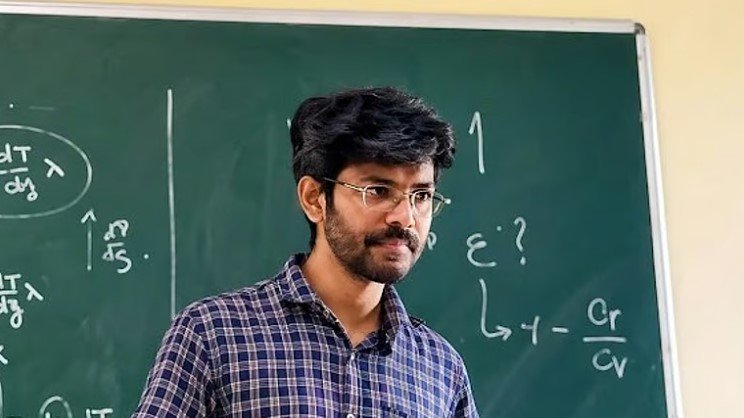
Gumavati Dr. Atanu Nath an Assistant Professor of Physics at Tihu College in Assams Nalbari district has been awarded the 2026 Breakthrough Prize in Fundamental Physics which is also known as the Oscars of Science. This is part of a global collaboration of 376 scientists who were recognized for their work on the Muon g 2 experiments that were carried out at Fermilab CERN and Brookhaven National Laboratory
Nath who comes from Lalabazar in Hailakandi district is one of approximately eleven Indian scientists who are honored for helping measure the anomalous magnetic moment of the muon an elementary particle whose behavior could reveal new physics beyond the Standard Model.
Recent reports indicate that Nath is the only awardee among the Indian recipients who are currently living and working in India. This makes his recognition especially important for regional academia. Assam and the northeast have all celebrated the achievement with educational institutions policymakers and the scientific community praising his contribution to global physics research
Dr. Nath who is an assistant professor of physics in Tihu College has drawn admiration across the region for his journey from a small town in Assam to the global stage of particle physics
He was born in Lalabazar in Hailakandi district and started studying physics before joining the international Muon g 2 collaboration a decades-long scientific project that included researchers from institutions around the world. A small but significant group of awardees are Indian researchers the Breakthrough Prize recognizes the collective contributions of 376 scientists who collaborated on this experiment
At Tihu College faculty and students held a felicitation ceremony to commemorate Naths achievement. They marked the occasion with traditional Assamese respect symbols like the phulam gamosa
Principal Dr. Suresh Bharali praised Naths achievement calling it a matter of great pride for the institution and Assam as well as the entire northeast. Academics have emphasized that Naths recognition shows that colleges and institutions far beyond Indias major research centers can make significant contributions to cutting-edge global science. (Institutions)