
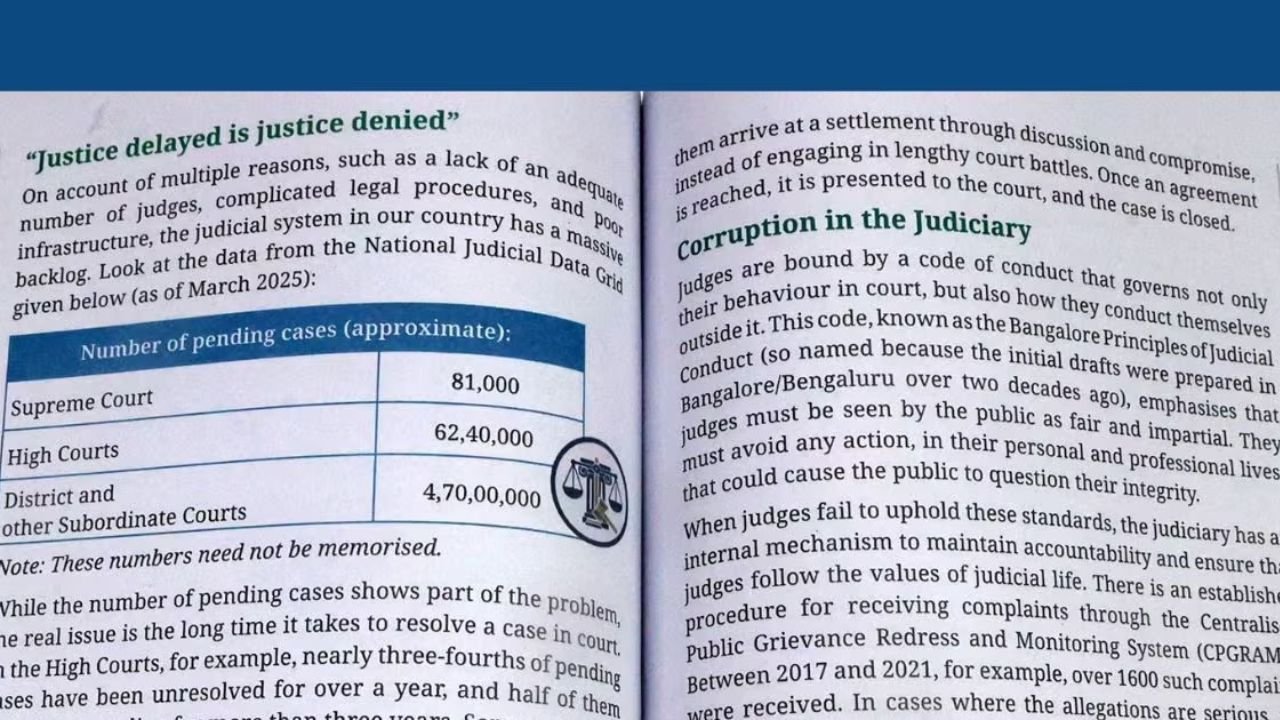
The National Council of Educational Research and Training (NCERT) recently released a new Social Science textbook for Class 8. This year, the textbook marks a significant change. While previously focused on the role of the judiciary, the structure of courts, and how an independent judiciary operates, students are now also exposed to the challenges facing the justice system. The new textbook explicitly addresses issues such as “corruption in the judiciary” and court backlogs.
The new book reveals a significant backlog of cases in the country’s courts. Using statistics, students are given an understanding of the pressure on the judicial system. According to the book, approximately 81,000 cases are pending in the Supreme Court of India. Meanwhile, approximately 6,240,000 cases are pending in the High Courts of India. Additionally, approximately 47,000,000 cases are still pending in district and subordinate courts.
The book lists several reasons behind these pending cases. Among these, the shortage of judges, the complexity of legal procedures, and the lack of adequate infrastructure in the courts are cited as the main reasons. It attempts to make students understand that delivering judgments is not just a challenge, but that running the entire system effectively is also a significant responsibility.
This time, the book also highlights instances of corruption and misconduct within the judiciary. The chapter states that while the judiciary is a crucial pillar of democracy, it also faces numerous challenges. Corruption at various levels is described as a serious problem that can make access to justice difficult, especially for the poor and marginalized. The book also clarifies that judges are bound by a code of conduct. They must maintain dignified and impartial behavior not only within the courtroom but also in their private lives.
If a complaint is made against a judge, there is a prescribed procedure. If a judge faces serious allegations, Parliament has the power to remove him or her from office through the process of impeachment. This process is lengthy and involves investigation, in which the judge concerned is given a full opportunity to present his or her case. The book thus explains the system of balance and accountability within a democratic framework.
Complaint and accountability system
The new book also describes the Centralized Public Grievance Redress and Monitoring System (CPGRAMS), through which complaints can be filed. According to the book, more than 1,600 complaints were filed between 2017 and 2021. This helps students understand that a system of accountability exists within the judiciary.
Statement by former Chief Justice
The chapter also cites a statement by former Chief Justice of India B.R. Gavai. According to his statement in July 2025, incidents of corruption and misconduct have also surfaced within the judiciary. He stated that such incidents undermine public confidence. He also stated that only transparent, prompt, and strict action can restore public trust. He described transparency and accountability as essential attributes of democracy.
Example of Electoral Bonds and IT Act
To help students better understand the topic, the book also provides two important examples: electoral bonds and information technology law. The book explains that in 2018, the government launched an electoral bond scheme, under which individuals and companies could secretly donate to political parties. The Supreme Court of India later declared this scheme unconstitutional. The court stated that voters have the right to know who is funding political parties. This example helps students understand how courts protect the Constitution.
The second example relates to the Information Technology Act, 2009. The book explains that a provision was added to this law that could lead to imprisonment for posts made on social media or the internet. In 2015, a law student challenged this provision. The Supreme Court subsequently struck it down, citing it as an infringement of freedom of expression. Students are asked to explain the court’s decisions in these cases and the constitutional reasoning behind them.
How different is it from the old book?
The earlier book, which was based on the 2005 syllabus, covered topics such as the independence of the judiciary, the structure of courts, and citizen access. It did mention that cases take years to be resolved and the adage “Justice delayed is justice denied.” However, issues such as corruption were not directly addressed.
Following the COVID-19 pandemic, the old syllabus was rationalized and several sections were reduced. Now, the curriculum has been redesigned under the New Education Policy 2020 and the National Curriculum Framework (NCF). New textbooks for classes 1 to 8 have already been released, and this change is part of that process.