
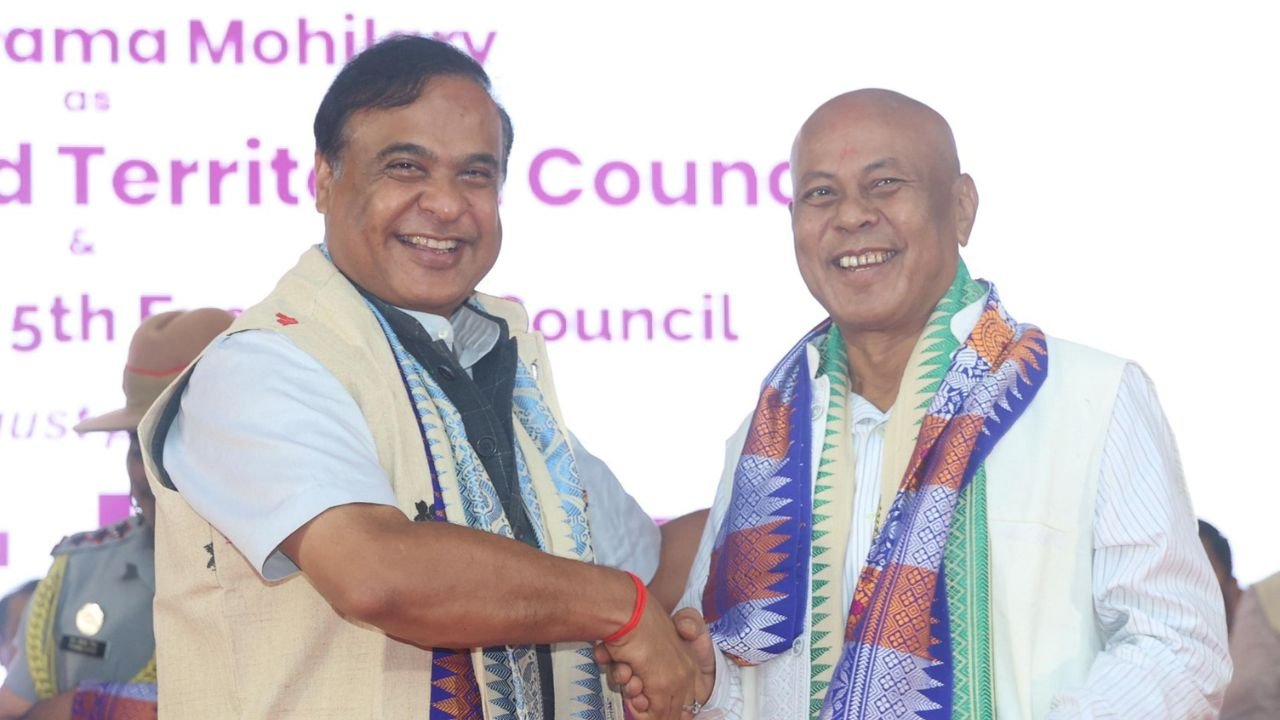
In a major political development in Assam’s Kokrajhar district on Sunday, October 5, Bodoland People’s Front (BPF) president Hagrama Mohitlari was sworn in as the Chief Executive Member (CEM) of the Bodoland Territorial Council (BTC). Former minister Rihon Daimary was sworn in as the Deputy Chief Executive Member at the swearing-in ceremony held at the Bodoland Secretariat grounds amid heavy rain. Assam Governor Laxman Prasad Acharya, Chief Minister Himanta Biswa Sarma, several cabinet ministers, and Tripura’s Tipra Motha Party chief Pradyot Bikram Manikya Debbarma were also present. The event highlighted the BTC’s importance in northeastern Indian politics.
BPF’s Big Victory and Shift in the Political Landscape
The BPF secured a landslide victory in this year’s BTC elections, returning to power by winning 28 out of 40 seats. The BPF had lost power last time to the United People’s Party Liberal (UPPL) and BJP alliance. This time, the UPPL won only seven seats, while the BJP was limited to five. Congress was completely defeated this time, losing none of its seats. Following the announcement of the election results, a BPF delegation led by Hagrama Mohitalary met Governor Acharya and staked claim to form the new council government. This victory signals a significant shift not only for the BPF but also for the political direction of the Bodoland region.
Congratulations to Shri @HagramaOnline for taking oath as the CEM of Bodoland Territorial Council along with his team of EMs.
I am confident that they will serve the people with zeal and fulfill Bodofa Upendranath Brahma's dream of a Shining Bodoland.
The Govt of Assam will… pic.twitter.com/WkkZRhwRRv
— Himanta Biswa Sarma (@himantabiswa) October 5, 2025
BTC and Hagrama Mohitalary’s Plan
The Bodoland Territorial Council (BTC) is the core of the administration and political structure of the Bodoland Territorial Region (BTR). It spans four districts—Kokrajhar, Chirang, Baksa, and Udalguri. The BTC’s primary objective is to provide greater autonomy to the Bodo community and accelerate regional development. A total of 316 candidates contested this year’s BTC elections across five districts—Kokrajhar, Chirang, Udalguri, Baksa, and Tamulpur. Of the 40 constituencies, 30 are reserved for Scheduled Tribes (STs), five for non-STs, and the remaining five are for the general category. Over 2.6 million voters exercised their franchise at a total of 3,279 polling stations. After taking oath, Hagrama Mohitalary reiterated his commitment to bring peace, prosperity, and progress to the region.
Future Challenges and Political Impact
The BPF’s victory has marked a major shift in the political landscape of Bodoland. Hagrama Mohitalary, who previously served as the BTC chairman several times, will now face the challenge of uniting various communities and ensuring economic development and political stability. Rihon Daimary also promised to focus on unemployment, land-related issues, and youth empowerment. Political analysts see this as a sign of growing dissatisfaction among the regional voters, which was related to land, employment, and administrative matters. The BPF’s return to power, amid cheers from supporters during the swearing-in ceremony, has raised new hopes for autonomy, inclusion, and sustainable development in Bodoland.