
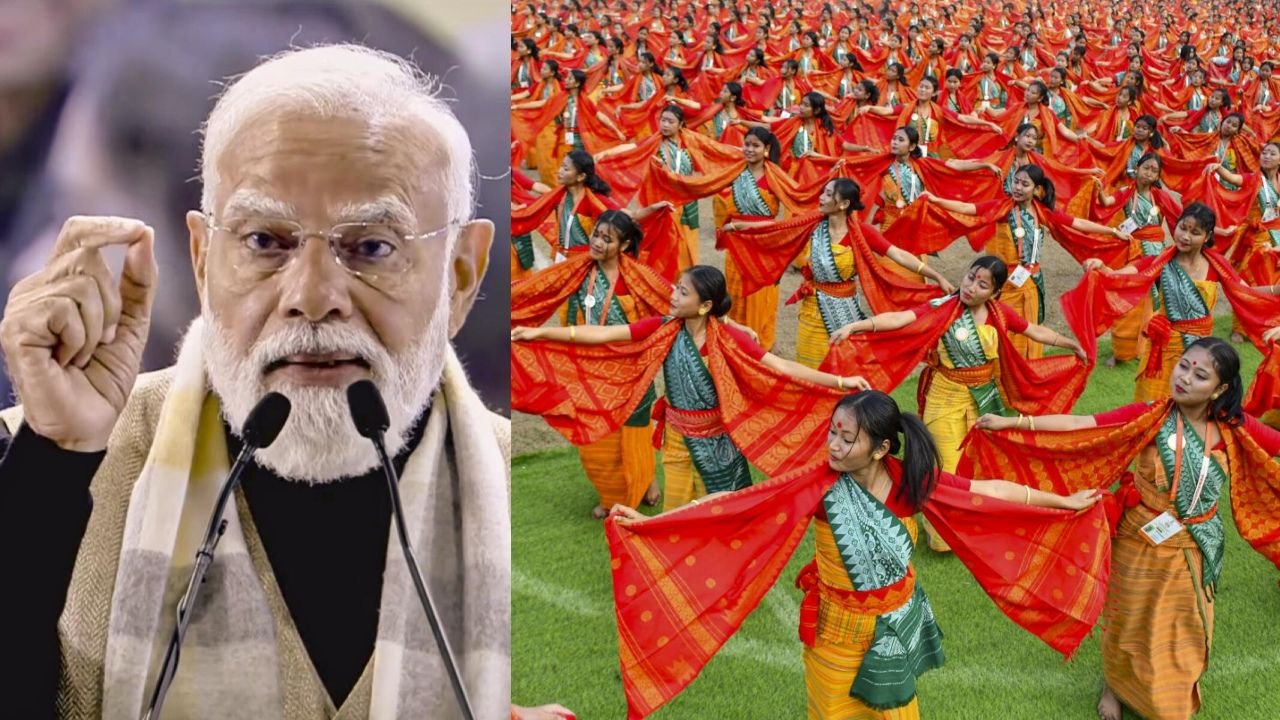
Prime Minister Narendra Modi has arrived in Assam to begin his two-day visit to the poll-bound state. On the evening of January 17, he will attend a spectacular cultural event in Guwahati where over 10,000 artists will perform the traditional Bodo folk dance called Bagurumba. This dance, deeply rooted in the Bodo community, is famous for its graceful movements that mimic the fluttering of butterflies. Practiced for centuries, Bagurumba is not just a dance but a celebration of nature’s beauty, performed predominantly by Bodo women. The event is being hailed as one of the largest cultural gatherings in Assam, highlighting the vibrant heritage of the region. Assam’s Chief Minister Himanta Biswa Sarma expressed enthusiasm on social media, emphasizing the state’s ambition to take this folk art form to the global stage.
The Cultural Significance of Bagurumba Dance
Bagurumba is an integral part of the Bwisagu festival, symbolizing respect and harmony with nature. Traditionally, women from the Bodo community perform this dance wearing colorful handwoven garments such as dokhna, jwmgra, and aronai, while the men play traditional musical instruments. The music involves unique handmade percussion instruments like the kham, a drum crafted from wood and goatskin, along with the bamboo flute (sifung), and wooden instruments like jota, gongwna, and tharkha. This artistic expression is a vibrant display of the community’s connection to their environment and cultural roots. Ahead of the event, the Chief Minister held video conferences with district officials to ensure flawless coordination and logistics, reflecting the government’s dedication to showcasing this rich cultural legacy with pride and smooth execution.
The stage is all set, the performers are pumped up.#BagurumbaDwhou – just a few hours to go! pic.twitter.com/PfSiC6CQLy
— Himanta Biswa Sarma (@himantabiswa) January 17, 2026
From Conflict to Cultural Revival
The Bodo community’s journey from years of violent militancy to a flourishing cultural milestone is remarkable. During the 1980s and 1990s, the region faced intense conflict due to militant groups fighting for autonomy, causing widespread violence and displacement. A turning point came in 2003 when the Bodo Territorial Council (BTC) accord was signed between the Bodo Liberation Tigers (BLT) and the government, leading to the surrender of weapons and political empowerment under the leadership of Hagrama Mahilary. However, militant violence resurfaced with groups like the National Democratic Front of Bodoland (NDFB) opposing the accord and demanding a separate Bodo state. Between 2014 and 2015, clashes caused turmoil, but the government’s persistent efforts eventually brought these groups to the negotiation table.
The peace process gained momentum when over 1,600 active NDFB militants surrendered in January 2020, marking a significant step towards reconciliation. In 2021, another faction, the National Liberation Front of Bodoland (NLFB), followed suit. These surrenders demonstrate a firm commitment to peace and development, with former militants reintegrating into mainstream society supported by rehabilitation initiatives. Today, the Bodoland Territorial Region (BTR), comprising Kokrajhar, Chirang, Baksa, and Udalguri districts, covers about 35% of Assam’s land area. The central and state governments, working closely with the regional BTC government, are focused on driving development and prosperity in the region. This collaboration aims to usher in a golden era for the Bodo people, preserving their ancient heritage while promoting peace and progress within the constitutional framework.